A crown is a covering that fits over a prepared tooth and restores its shape, size and function. It is made in a laboratory — commonly in zirconia, porcelain fused to metal, or all-ceramic — and cemented onto the tooth. Where a filling repairs part of a tooth, a crown holds the whole of it together.
What it may help with
- A tooth that is so heavily filled that little sound structure remains.
- A cracked tooth, or one at risk of splitting.
- A tooth that has had root canal treatment, particularly a back tooth.
- A tooth that has fractured a cusp.
- Substantial wear, where the shape and height of the tooth need restoring.
- Completing an implant or anchoring a bridge.
Examination and suitability
Your dentist examines the tooth and takes an X-ray to check the root, the surrounding bone and any existing root filling. A crown needs enough sound tooth to sit on; where too little remains, a post or a core build-up may be required first, and occasionally the tooth cannot be saved at all. Gum health is assessed at the same time, because a crown placed on an inflamed foundation will not do well.
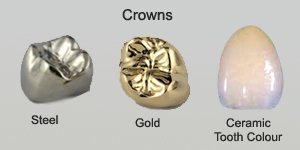
Material choice follows the situation rather than the price list: where the tooth sits in the mouth, how much room there is, what the bite is doing and how visible the tooth is all come into it. Your dentist will explain the options for your tooth and what each one involves.
What usually happens
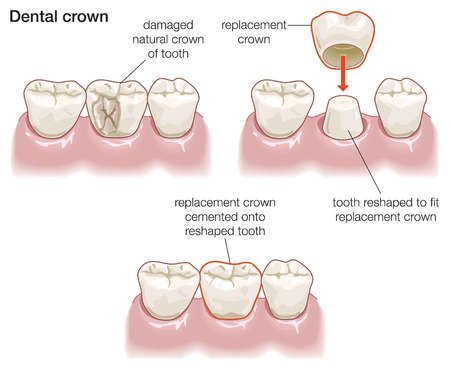
- Local anaesthetic is given and the tooth is shaped to make room for the crown.
- An impression or digital scan is taken, along with the shade.
- A temporary crown is fitted while the laboratory makes the permanent one.
- At the second visit the crown is tried in, the fit, contact points, shade and bite are checked, and it is cemented.
How many visits to expect
Usually two appointments separated by laboratory time — commonly about a week — with the first around 60 to 90 minutes. If a post, a core build-up or root canal treatment is needed first, add appointments for those. Your dentist will give you a sequence and an estimate after the examination.
Limitations, risks and alternatives
- Preparing a tooth for a crown is irreversible.
- Sensitivity after preparation is common and usually settles; occasionally a prepared tooth needs root canal treatment afterwards.
- Decay can still form where the crown margin meets the tooth, so cleaning that line matters.
- A crown has a working life that varies with the bite, hygiene and habits such as grinding. It is a long-term restoration that needs review, not a permanent one.
- Ceramic can chip; a temporary crown can come off between visits, which is inconvenient rather than serious.
- Alternatives depend on the tooth and may include a large filling, an inlay or onlay, or removal followed by an implant, a bridge or a denture.

After your treatment
With a temporary crown, avoid sticky and very hard food and floss out sideways rather than upwards. Once the permanent crown is cemented, clean it as you would a natural tooth, paying attention to the gum margin. Contact the clinic if the bite feels high, if the crown or temporary comes off, or if the gum around it stays sore.
Treatments and indicative pricing
Prices are indicative and durations are estimates. Your own quote and timing follow an examination and diagnosis at the clinic.
Crossed-out figures marked “elsewhere” are prices that other dental clinics in Thailand, in Bangkok and in Phuket, publish on their own websites for the comparable treatment, as read on 14 September 2026; they are not prices of this clinic. The crossed-out figure on teeth whitening is this clinic’s own regular price. Our figure is the one the treatment starts from; the dentist confirms your own quote after the examination.
Ready to talk it through?
Request an assessment and the dentist will explain which options suit you, how long they take and what they are estimated to cost.