
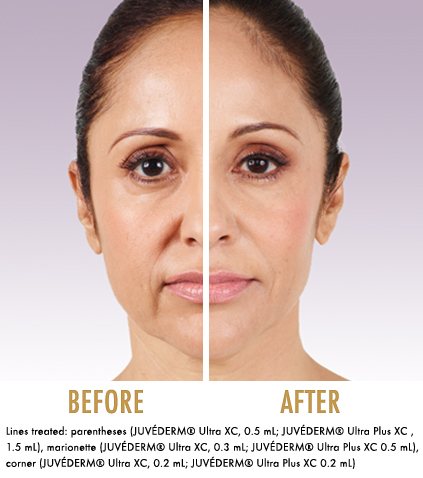
Dermal fillers are gels of cross-linked hyaluronic acid — a substance that occurs naturally in skin — injected beneath the surface to soften a fold or add contour in a selected area. The effect is temporary: the gel is gradually broken down by the body over a period that varies with the product, the site and the individual.
What it may help with
- Nasolabial folds and marionette lines.
- Lip shape and definition, where that is what you want and the anatomy allows it.
- Cheek and chin contour in selected cases.
- Loss of volume associated with ageing.
Filler adds volume. It does not tighten loose skin, does not treat surface texture or pigmentation, and does not remove the muscle activity behind expression lines — that is a different treatment with different considerations.

Assessment and suitability
A consultation covers your medical history, allergies, medication including anticoagulants, autoimmune conditions, previous aesthetic treatment — particularly any permanent or semi-permanent filler, which changes what can safely be done — and what you are hoping to achieve. Photographs are taken and written consent is obtained.
Filler is not carried out during pregnancy or breastfeeding, where there is active skin infection or inflammation at the site, or where there is a known allergy to a component. Certain areas of the face carry a materially higher risk than others and are approached with corresponding caution, or declined.
What usually happens
- The area is assessed, marked and photographed.
- The skin is cleansed. Topical anaesthetic can be applied; many products also contain lidocaine.
- The filler is injected with a needle or a cannula, in small increments, with the effect assessed as it goes.
- The area is gently moulded where appropriate and cooled.
- An appointment takes roughly 30 to 45 minutes including preparation.
How many visits to expect
Usually one appointment, with a review a couple of weeks later where a top-up may be discussed. Because the effect is temporary, maintaining it means repeat treatment — commonly somewhere between six and eighteen months apart depending on the product, the area and the individual. Your practitioner will give you an estimate for the product used in your case.
Limitations, risks and alternatives
- Swelling, bruising, redness and tenderness in the first days are common. Lips swell more than most areas.
- Lumps or asymmetry can occur and may need review, moulding or, in some cases, dissolving with hyaluronidase.
- Infection, prolonged swelling and delayed nodules are recognised though uncommon.
- Vascular occlusion — filler entering or compressing a blood vessel — is rare but serious, and can affect skin or, very rarely, vision. It is a medical emergency, which is why treatment should only be carried out by a trained practitioner with hyaluronidase on the premises and an emergency protocol in place.
- The result is temporary and cannot be specified exactly in advance.
- Alternatives include no treatment, skincare and sun protection, or other procedures. Doing nothing is a legitimate option and is always on the table here.
After your treatment
Avoid heavy exercise, saunas, steam and alcohol for around 24 hours, and avoid pressure on the treated area. Do not have facial massage or other facial treatments for two weeks without asking first. Contact the clinic immediately — the same day — if you develop severe or increasing pain, skin that goes white, dusky or mottled, or any change in vision. These are the signs the emergency protocol exists for.
Ready to talk it through?
Request an assessment and the dentist will explain which options suit you, how long they take and what they are estimated to cost.