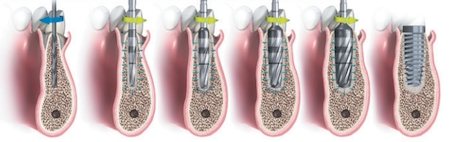
A dental implant is a small titanium post placed into the jawbone to take the place of a tooth root. Over a period of healing the bone integrates with its surface, and a crown, bridge or denture is then attached to it. Implant treatment is a surgical procedure planned from imaging and a full assessment.
What it may help with
- Replacing a single missing tooth without preparing the teeth beside it.
- Replacing several missing teeth with an implant-supported bridge.
- Stabilising a loose lower denture.
- Restoring the ability to chew on a side where a tooth has been lost.

Examination and suitability
Suitability is decided by the examination, not by the request. Your dentist assesses the height and width of bone at the site, the health of your gums, the position of the sinus and the nerve, how your teeth meet, and your general health. A CT scan is commonly used, because the measurements that matter are not visible on a standard X-ray.
Several things affect whether an implant is a sound choice and how well it is likely to do: uncontrolled diabetes, smoking, active gum disease, some medications affecting bone, radiotherapy to the jaws, and heavy grinding. None of these is automatically a bar, and all of them change the plan. Where bone is insufficient, a graft or a sinus lift may be proposed as a preliminary stage — with its own healing time.

What usually happens
Assessment and planning
Examination, X-rays and usually a CT scan. Your dentist explains what is possible, the sequence, the estimated number of visits and the estimated cost before anything begins.
Any preparatory treatment
Gum treatment, removal of an unrestorable tooth, or bone grafting where the site needs it. Each of these has its own healing period.
Implant placement
Carried out under local anaesthetic. The implant is placed into the bone and the gum is closed over or around it.
Healing and integration
The bone integrates with the implant surface, commonly over a period of a few months. A temporary tooth can often be arranged for a visible gap during this time.
The restoration
An impression or scan is taken and the crown, bridge or denture attachment is made and fitted.
Review and maintenance
Implants need regular professional cleaning and monitoring for as long as they are in place.

How many visits to expect
Implant treatment is usually spread over several months rather than several days, because the healing period is what the result depends on. A common pattern is a planning visit, a surgical visit, a healing period of roughly three to six months, then two visits for the restoration. Immediate approaches exist and suit some cases; they are decided at assessment, not in advance. If you are visiting Phuket, tell us how long you are here and we will explain honestly what can and cannot be completed in that time.
Limitations, risks and alternatives
- An implant is a long-term option that requires maintenance and review. It is not permanent and it is not guaranteed.
- Implants can fail to integrate, or can be lost later — most often through peri-implantitis, an inflammatory condition around the implant driven by plaque, and more likely in smokers and in people with a history of gum disease.
- Surgical risks include swelling, bruising, bleeding, infection and, depending on the site, effects on the sinus or on nerve sensation. Your dentist will discuss the risks specific to your site.
- Local anaesthetic is used for placement. Discomfort and recovery vary between people and between cases.
- An implant crown can chip or loosen and its components may need servicing.
- Alternatives are a bridge, a removable denture, or accepting the gap. A bridge may avoid surgery; an implant may avoid preparing neighbouring teeth. Which is preferable depends on your mouth, not on a general ranking.

Common questions
Is the placement painful?
The procedure is carried out under local anaesthetic. Afterwards, swelling and soreness for a few days are common and are usually managed with ordinary painkillers. How much discomfort you have varies from person to person.
How long do implants last?
Published studies report high survival rates over ten years and beyond, but those are population figures, not a promise about your implant. Longevity depends on gum health, cleaning, smoking, grinding, general health and regular maintenance.
Can I have the implant and the crown on the same trip?
Sometimes, and often not. It depends on bone quality, whether grafting is needed and how the implant behaves during healing. We will tell you what is realistic for your case after the assessment rather than before it.
Will anyone be able to tell?
An implant crown is made to match the shade and shape of the teeth around it. How closely it can be matched depends on the site, the gum line and the neighbouring teeth.
What if I smoke?
Smoking is associated with a higher rate of implant complications and failure. It does not automatically rule treatment out, but it is a factor your dentist will discuss with you openly before you decide.
After your treatment
Follow the after-care instructions you are given for the first days, keep the area clean as directed, and avoid smoking during healing. Attend the review appointments — the point of them is to find a problem while it is still small. Contact the clinic if swelling increases after the first few days, if there is persistent bleeding, if the area becomes more painful rather than less, or if an implant crown feels loose.
Treatments and indicative pricing
Prices are indicative and durations are estimates. Your own quote and timing follow an examination and diagnosis at the clinic.
Crossed-out figures marked “elsewhere” are prices that other dental clinics in Thailand, in Bangkok and in Phuket, publish on their own websites for the comparable treatment, as read on 14 September 2026; they are not prices of this clinic. The crossed-out figure on teeth whitening is this clinic’s own regular price. Our figure is the one the treatment starts from; the dentist confirms your own quote after the examination.
Ready to talk it through?
Request an assessment and the dentist will explain which options suit you, how long they take and what they are estimated to cost.